Villas for rent in Piedmont: Private Wine, Truffle and Langhe Experiences

Piedmont at a Glance
Best Time to Visit October for truffle season and harvest. April–May for spring. September for vendemmia.
Recommended Duration 4 nights minimum in the Langhe. 7 nights if combining with Turin.
Starting From €180 per person (Truffle Hunting experience)
Top Experiences Dawn truffle hunt with a trifulau family, Barolo cellar visits with introduction, tajarin with white truffle shavings, bagna cauda in winter
Getting There Turin Caselle (TRN) direct. Milan Malpensa (MXP): 1 hour by car. High-speed train Turin–Milan: 1 hour. Turin–Paris via TGV: 3.5 hours.

Why Piedmont Now?

The Langhe hills are UNESCO World Heritage. The coaches have not yet arrived.

I have been taking clients to Piedmont for fifteen years. In that time the Langhe hills received UNESCO World Heritage status (2014), Barolo became one of the most discussed wines in the world, and the white truffle of Alba sold at auction for prices that made international news. None of this changed the fundamental character of the place. The restaurants still close on Sunday. The winemakers still prefer to know who you are before they open the good bottles. The trifulau families still guard their truffle grounds the way their grandfathers did.

This is what I mean when I say Piedmont is what Tuscany was thirty years ago. Tuscany before the cooking schools multiplied on every hillside and the rental cars queued at the gates of Montepulciano. Piedmont is a region that has not yet learned to perform itself for visitors. The food culture here is old and serious and not particularly interested in adapting itself to what tourists expect Italian food to be. The wines require patience to understand and patience to age. The truffles cannot be grown on demand. Everything about this region resists the tourism that the rest of Italy has accommodated.

That is precisely why I recommend it first to clients who have done Tuscany.

Barolo and Barbaresco: The Wines That Require Patience

38 months aging by law. 11 communes. One grape: Nebbiolo.

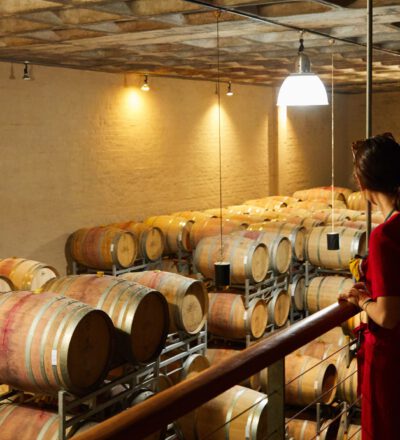
Barolo is a DOCG wine made from 100% Nebbiolo and is subject by law to a minimum of 38 months of aging from November 1 of the harvest year, with at least 18 months in wood. Riserva requires 62 months. The wine is called the King of wines and wine of kings, which is the kind of designation that gets attached to things that earned it over centuries rather than through marketing. The tannins in a young Barolo are formidable. A bottle opened too early produces a wine that tastes like disagreement. The same bottle opened ten years later produces something of a different order entirely.

The zone covers 11 communes in the Langhe hills south of Alba. Each has its own soil character. La Morra produces Barolo with more aromatic complexity. Serralunga d’Alba produces Barolo with more structure and tannic grip. Castiglione Falletto sits between them in character, as it does geographically. Monforte d’Alba and Barolo village complete the five most discussed communes, though producers in all 11 make wine worth understanding. This is Burgundy logic applied to Italian terrain: the same grape, the same general zone, but the specific hillside determines the wine.

In the 1980s a group of young Piedmontese winemakers, later called the Barolo Boys, challenged the traditional style. Elio Altare, Domenico Clerico, and others introduced French barriques and shorter maceration times, producing wines that were more immediately accessible but divided the traditionalists. The debate lasted two decades and produced better wine on both sides. Today the best producers draw from both approaches. What this means for a visitor is that Piedmont’s wine culture has depth and argument and living history. It is not a museum.

Barbaresco, Barolo’s neighbor, is also 100% Nebbiolo, smaller in production zone, and requires 26 months of aging rather than 38. Angelo Gaja is the most famous producer in the world, and his wines have done more than any single producer to establish the international reputation of both Barbaresco and Piedmontese wine generally. The wine is called the Queen of wines in the same tradition that named Barolo the King.

I will tell clients directly: the best producers in Barolo and Barbaresco are not set up for drop-in visitors. Most do not have tasting rooms in the commercial sense. Access requires an introduction. Our Barolo Wineries experience (€245/pp) exists precisely because of relationships built over fifteen years with producers who will receive clients personally, open bottles that do not appear on any public allocation list, and explain the differences between their communes with the specificity that comes from having spent their lives on these hillsides.

The White Truffle of Alba

Cannot be cultivated. Most expensive food on earth by weight. October to December.

The white truffle of Alba, Tuber magnatum pico, is the most expensive food in the world by weight. Prices at the 2026 season are in the range of €3,000 to €5,000 per kilogram depending on size and quality, with exceptional specimens selling at auction for multiples of that. The reason for the price is not scarcity in the commercial sense. It is impossibility. The white truffle cannot be cultivated. Unlike the black truffle of Périgord, which responds to inoculation and controlled growing conditions, the white truffle grows only in wild symbiosis with specific oak, hazel, and poplar trees, in specific soil conditions, in a zone that extends across parts of Piedmont, Tuscany, and Umbria. You cannot farm it. You can only find it.

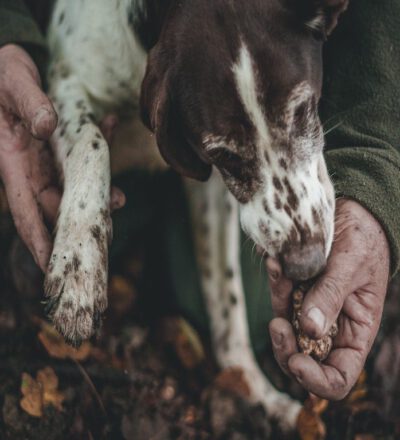
The people who find it are called trifulau. Truffle hunting families in Piedmont pass their knowledge from generation to generation: the locations of productive grounds, the seasonal indicators that signal a good year, the training of the dogs (since 1985 pigs have been prohibited for truffle hunting in Italy, as they damage the underground mycelia). A good truffle dog, usually a Lagotto Romagnolo, trains for years. The trifulau goes out before dawn, in conditions and locations he guards as carefully as any commercial secret. The knowledge of where to find truffles is treated with more discretion than financial information in this part of Piedmont.

The season runs from October through December, with the peak in October and November. The International Alba White Truffle Fair, started in 1929 by Giacomo Morra, runs through these months. The 2026 edition, the 96th, runs from October 10 to December 6 at the Cortile della Maddalena in Alba. There are tastings, auctions, and a market where you can buy truffles directly from certified vendors.

The distinction between a commercial truffle experience and a genuine one is significant. The commercial version involves a guide, a dog, and a pre-identified patch where the truffle will certainly be found. It is fine. It is not what we offer. Our Truffle Hunting experience (€180/pp) goes out at dawn with a trifulau family that has hunted these hills across multiple generations. The ground covered is real. The outcome is not guaranteed. When the dog finds something and the man kneels in the fog in the Langhe hills and lifts a truffle out of the earth the size of a small fist, the smell is one of the most specific things I know of in food. The lunch that follows, with white truffle shaved over tajarin pasta, is the point of the entire journey.

The Food Philosophy: Slow Food Was Invented Here

Carlo Petrini, Bra, 1989. Not a trend. A response to McDonald’s.

In 1989, Carlo Petrini from Bra signed the international Slow Food manifesto in Paris with delegates from fifteen countries. The organization he founded had its roots in a protest four years earlier against McDonald’s opening near the Spanish Steps in Rome, but its ideology was entirely Piedmontese: the conviction that food is culture, that fast food is an assault on culture, and that the right response is to eat slowly with the people who grew what you are eating. The Slow Food headquarters remain in Bra. The University of Gastronomic Sciences, founded by Petrini in 2004, occupies the medieval village of Pollenzo nearby and has become one of the few universities in the world where food is treated as a serious academic subject. The Banca del Vino at Pollenzo holds over 100,000 bottles and functions as a living archive of Italian wine culture.

This context matters for visiting Piedmont because the Slow Food philosophy is not a marketing concept here. It is the actual description of how the food culture operates. The farmer who grows the Tonda Gentile delle Langhe hazelnut, the variety that Ferrero has used since Pietro Ferrero founded the company in Alba in 1946, is growing a product with a specific local identity that predates the brand. Nutella, launched in 1964, is a Piedmontese invention built on a Piedmontese ingredient. The region produces things rather than performing the production of things.

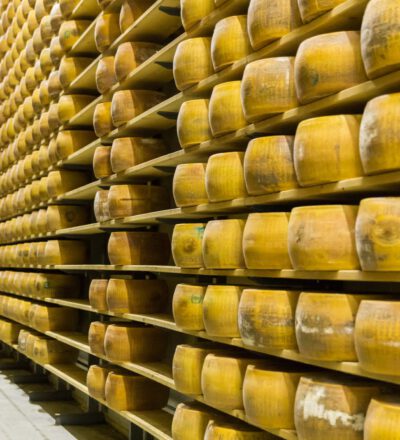
The food itself: tajarin is a pasta made with 30 or more egg yolks per kilogram of flour. The standard egg pasta recipe uses two or three. The result is a pasta with an intensity of flavour that feels like it is doing something different from ordinary pasta. Agnolotti del plin are small pasta parcels pinched shut around a filling of roast meat; the name comes from the Piedmontese word for the pinching action used to seal each parcel. Bagna cauda is a communal winter dish: anchovies and garlic dissolved in olive oil over heat, served in a terracotta brazier called a fujot, into which you dip raw vegetables, cardoons, roasted peppers. The dish is designed to be eaten slowly, with wine, around a table, in cold weather. It does not photograph well and does not need to. The Balsamic and Parmesan experience (€240/pp) extends this food-at-source philosophy to the producers of Emilia Romagna adjacent to the Piedmont circuit.

For clients interested in combining the wine, food, and fashion of the north in a single journey, our North Italy Fashion and Gourmet tour (€5,900/pp) and A Taste of Northern Italy (€3,290/pp) both route through the Langhe as their core.

Langhe vineyards sunset panorama, Barolo, Piedmont, Italy Europe

Turin: Where Vermouth, Chocolate, and the Savoy Dynasty Converge

Vermouth invented 1786. Bicerin since 1763. Gianduja from Napoleon’s blockade.

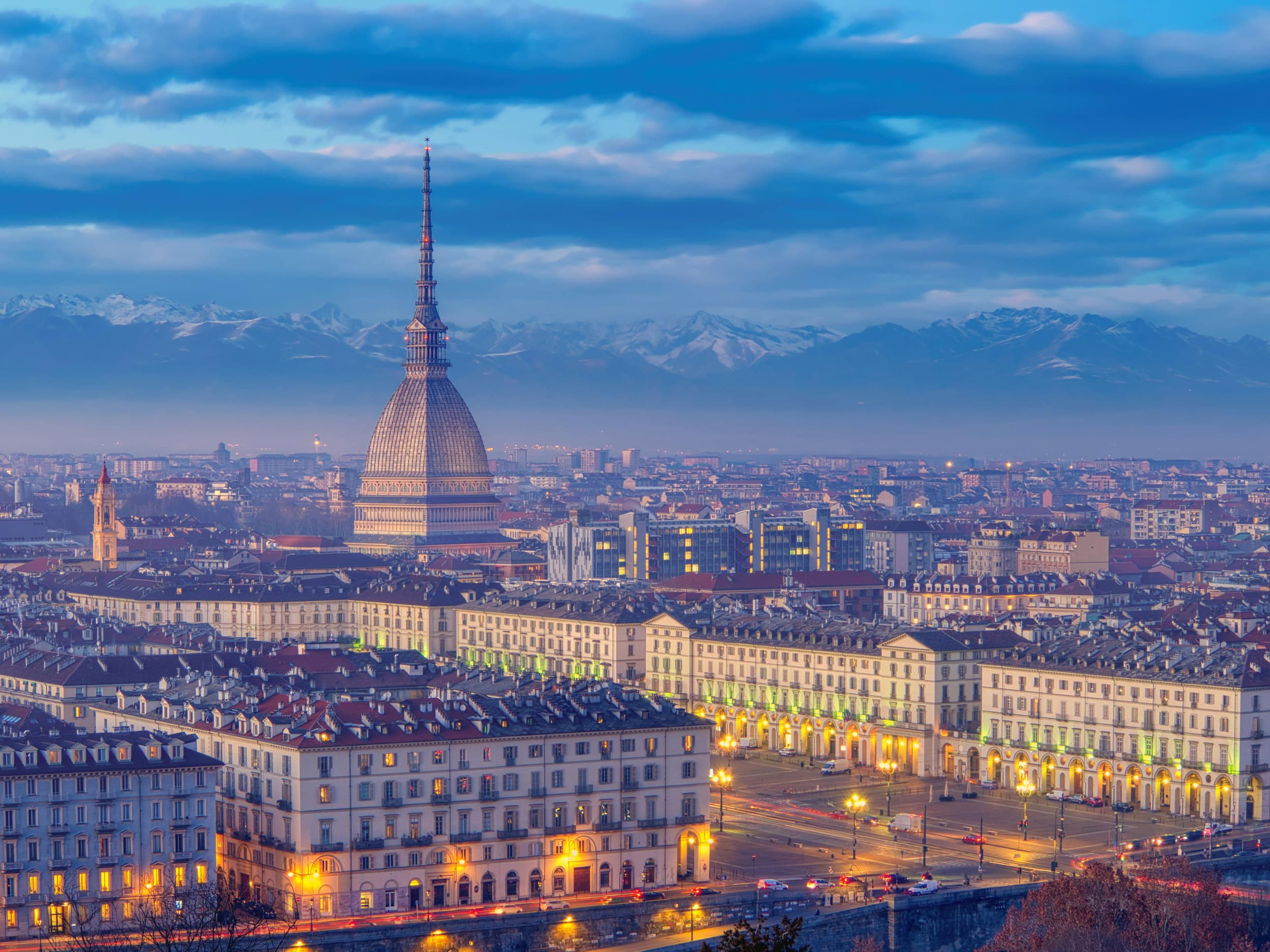
Turin is the regional capital and deserves more attention than it receives. Most visitors to Piedmont spend their time in the Langhe and treat Turin as the airport city. This is a reasonable allocation of time if you have only four days. It is a missed opportunity if you have seven.

The aperitivo tradition in Turin is not the bar-snacks-with-a-drink convention familiar from Milan. It derives from a specific history. In 1786, a wine merchant named Antonio Benedetto Carpano began selling a fortified wine blended with 30 or more herbs and spices from a shop near Piazza Castello. He called it vermouth, from the German Wermut for wormwood, one of the botanical ingredients. The drink was adopted by the Savoy royal household as the official aperitivo. Both Cinzano and Martini, the two names that have since become generic, originated in the same Turin commercial tradition. To have a vermouth in Turin at 6 in the evening in one of the historic bars near Piazza Carignano is to drink something with a specific origin in this specific city rather than a generic category.

Caffè Al Bicerin, founded in 1763 and still operating on the Piazza della Consolata, serves the drink that the café invented: a layered composition of espresso, hot chocolate, and cream in a small glass. Count Cavour drank here. Alexandre Dumas wrote about it. Nietzsche is recorded as a regular. The café has not changed its recipe or its appearance to accommodate the tourists who come specifically to see it unchanged.

The gianduja chocolate story belongs to the same period. During Napoleon’s continental blockade, cocoa became scarce and expensive. Turin chocolatiers, who had established the city as one of the great chocolate centres of Europe, extended their supplies by grinding the local Tonda Gentile delle Langhe hazelnut and mixing it with the cocoa. The result was a new thing. Gianduja. It was better than either ingredient separately. This is not the official founding story of Nutella, but it is the founding story of the ingredient combination that eventually became Nutella.

Turin is also the home of the Mole Antonelliana, the eccentric pointed spire that defines the city’s skyline and houses the National Museum of Cinema, and Porta Palazzo, described as the largest open-air market in Europe at 51,300 square metres, where the city’s actual residents shop every morning except Sunday. The Egyptian Museum in Turin holds one of the largest collections of Egyptian antiquities outside Cairo. None of these are on any standard Langhe itinerary, which is part of their appeal.

When Is the Best Time to Visit Piedmont?

October. Not a close call.

October is the month I recommend first and most emphatically. The white truffle season is at its peak. The vendemmia is happening across the Langhe hills, with baskets of Nebbiolo grapes moving from the vineyards into the cantine. The fog that forms in the valley floors in the early morning gives the hills a quality that has been painted and photographed for two centuries and cannot be replicated in any other month. Hotel rates are not inflated because this is not yet a mass-market destination. And the outdoor temperature, between 10 and 18 degrees, is exactly right for walking between producers and eating heavily at lunch.

Season Months Temperature Crowd Level Best For
Winter Dec–Feb 0–8°C Very Low Bagna cauda season, truffle tail end, ski resorts via Sestriere, lowest prices
Spring Mar–May 8–20°C Low–Medium Green hills, cellar visits, blossom. Vinitaly in Verona (April) attracts producers.
Summer Jun–Aug 22–32°C Medium Long evenings, outdoor dining, walking the hills. No truffle; wines pour well in summer heat.
September ★ Sep 14–24°C Low–Medium Vendemmia begins. Hills at their most active. Harvest lunches with producers.
October ★ Oct 10–18°C Medium Peak truffle season, harvest fog, Alba Fair opens October 10. The best month in Piedmont.
November Nov 5–12°C Low Truffle season continues. Atmospheric fog. Alba Fair through December 6. Quiet wineries.

A note on summer: I do not discourage July and August as I would in Venice or the Amalfi Coast. Piedmont in summer is in practice pleasant. There are no cruise ships. There is no Ferragosto chaos. The hills are green, the evenings are long, and the restaurants are busy with Italian visitors from Milan and Turin rather than international tourists. The truffle is not available, which is a material absence if truffle was the reason for the journey. If it was not, the summer Langhe is a very good place to be.

For clients visiting during the honeymoon season, I recommend September and early October without reservation. The light on the Langhe hills in late September, at the moment when the harvest begins and the leaves start to turn, is among the finest things I can direct a couple toward in all of Italy.

How Many Days Does Piedmont Require?

Four nights is the minimum. Seven nights allows the full picture.

Piedmont is not a destination that works as a day trip from anywhere, and it is not a destination where three nights produces a complete experience. The food and wine culture here is slow by design. The producers are not open for forty-five minutes and then closed. A proper cellar visit takes half a day. A truffle hunt starts before dawn and ends at lunch. The bagna cauda is a three-hour meal.

Nights What becomes possible What remains out of reach
3 nights Two Barolo communes. One truffle hunt or one cellar visit. The hill villages. Turin. Barbaresco zone. The pace that makes Piedmont itself.
4–5 nights Full Langhe circuit. Barolo and Barbaresco. Truffle hunt and cellar visit. Slow Food lunch at a producer. Turin. Lake Orta. Sacra di San Michele.
7 nights The full region. Two nights in Turin (vermouth, Bicerin, Mole Antonelliana, Porta Palazzo). Day trip to Lake Orta or Sacra di San Michele. The pace the region was designed for. Nothing. This is the complete Piedmont.

For clients who want a villa base for the Langhe, our Castel Garrone provides the kind of residence that makes the slower pace possible: a property from which you can drive to a morning cellar visit and return for lunch on the terrace with wine from the same producer you visited three hours earlier.


White truffle hunting Piedmont Italy trifulau dog forest Italy Charme private experience

Frequently Asked Questions About Visiting Piedmont

Is Piedmont worth visiting?
Yes, and for a specific reason: it is what Tuscany was before the tourism scaled beyond the region’s capacity to absorb it. The Langhe hills are UNESCO World Heritage. The white truffle of Alba is the most expensive food on earth by weight. Barolo requires 38 months of aging by law. And the food culture here, which invented the Slow Food movement, has not yet learned to perform itself for visitors. This is a region that repays depth of engagement rather than rapid sightseeing.
When is truffle season in Piedmont?
The white truffle of Alba season runs from October through December, with the peak in October and November. The International Alba White Truffle Fair, in its 96th year in 2026, runs October 10 to December 6 at the Cortile della Maddalena in Alba. If the white truffle is the primary reason for visiting, October is the month. If budget is a consideration, November offers comparable quality at the tail of the season with reduced demand.
What wine is Piedmont famous for?
Barolo and Barbaresco are the two names that matter most internationally. Both are made from 100% Nebbiolo. Barolo requires 38 months of aging (62 for Riserva) and covers 11 communes in the Langhe hills, each with distinct character. Barbaresco is smaller, requires 26 months minimum, and is most associated with Angelo Gaja. Beyond these two, Barbera d’Asti, Dolcetto d’Alba, Moscato d’Asti, and the sparkling Asti Spumante are all significant. Piedmont has more DOC and DOCG wine designations than any other Italian region.
How do I get to Piedmont?
Turin Caselle Airport (TRN) has direct flights from major European hubs and some transatlantic routes. Milan Malpensa (MXP) is approximately 1 hour by car and has more international connections, including direct flights from the US. High-speed train from Milan to Turin takes 1 hour. Paris to Turin via TGV takes 3.5 hours. For the Langhe specifically, a car is necessary once in the region: the hill villages are not connected by meaningful public transport and the cellar visits require flexibility of timing.
How many days do I need in Piedmont?
Four nights in the Langhe is the minimum for a visit that covers Barolo, Barbaresco, the hill villages, and one serious food experience. Seven nights allows Turin, Lake Orta, and the pace the region was built for. Three nights produces a compressed version of Piedmont: the landmarks but not the understanding. A morning truffle hunt followed by a cellar visit in a different commune followed by a Slow Food lunch at a producer is a full and unhurried day. Piedmont rewards the same patience that its wines require.
Piedmont vs Tuscany: which is better for a wine trip?
Different wines, different experience, different answer depending on what you want. Tuscany is more accessible: tasting rooms are common, the infrastructure for wine tourism is developed, and the landscape is well-known internationally. Piedmont requires more effort: the best producers do not have open tasting rooms, access to serious cellars requires introductions, and the wines need explanation to be understood. The reward for that effort is a wine culture that feels less like a managed attraction. If you have done Tuscany and want the next level, Piedmont is the answer. If you are visiting Italy’s wine country for the first time, both are extraordinary but Tuscany is easier to navigate independently.
What is the Langhe region?
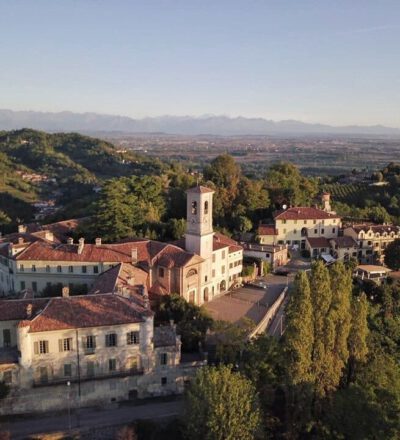
The Langhe is a hilly subregion in southern Piedmont, south of Alba, where the Barolo and Barbaresco DOCG zones are located. It forms part of the Vineyard Landscape of Piedmont UNESCO World Heritage Site designated in 2014. The hills run roughly east-west and are divided into named zones, each associated with distinct wine character. The villages of La Morra, Barolo, Castiglione Falletto, Serralunga d’Alba, and Monforte d’Alba are the most discussed, but the entire zone covers 11 Barolo communes. October fog settles into the valley floors while the hilltop villages remain clear, a visual condition that has defined the imagery of Piedmont wine culture for two centuries.
What food is Piedmont known for?
White truffle (October to December), Barolo wine, tajarin pasta (30+ egg yolks per kilogram of flour), agnolotti del plin (pinched pasta parcels with roast meat), bagna cauda (communal winter dip of anchovies, garlic, and olive oil), grissini breadsticks, gianduja chocolate, and Ferrero’s hazelnut products originating from Alba. The region is also where Carlo Petrini founded the Slow Food movement in 1989 and where the University of Gastronomic Sciences operates in Pollenzo. Piedmont has a higher density of Michelin-starred restaurants per capita than almost any region in Italy outside of Lombardy.
Is Turin worth visiting?
Yes. Turin is a Baroque city, the former capital of the Savoy dynasty and first capital of unified Italy. It invented vermouth (Antonio Benedetto Carpano, 1786), produced both Cinzano and Martini, invented gianduja chocolate during Napoleon’s cocoa blockade, and runs a café (Al Bicerin, since 1763) serving a drink that has not changed in 260 years. The Mole Antonelliana houses the National Museum of Cinema. Porta Palazzo is the largest open-air market in Europe. The Egyptian Museum holds one of the world’s most significant collections of Egyptian antiquities. Two nights in Turin at the beginning or end of a Langhe trip is not a diversion. It is the context that makes the Langhe comprehensible.
When is the Alba Truffle Fair?
The International Alba White Truffle Fair runs from October 10 to December 6 in 2026, the 96th edition of the event, held at the Cortile della Maddalena in Alba. The fair includes a certified truffle market where you can buy directly from vendors, tastings, and events. The first weekend of the fair is the busiest. Coming on a weekday in late October or early November gives access to the market without the weekend crowds. October is also the month when the combination of truffle peak, harvest activity, and Langhe fog makes the region at its most itself.