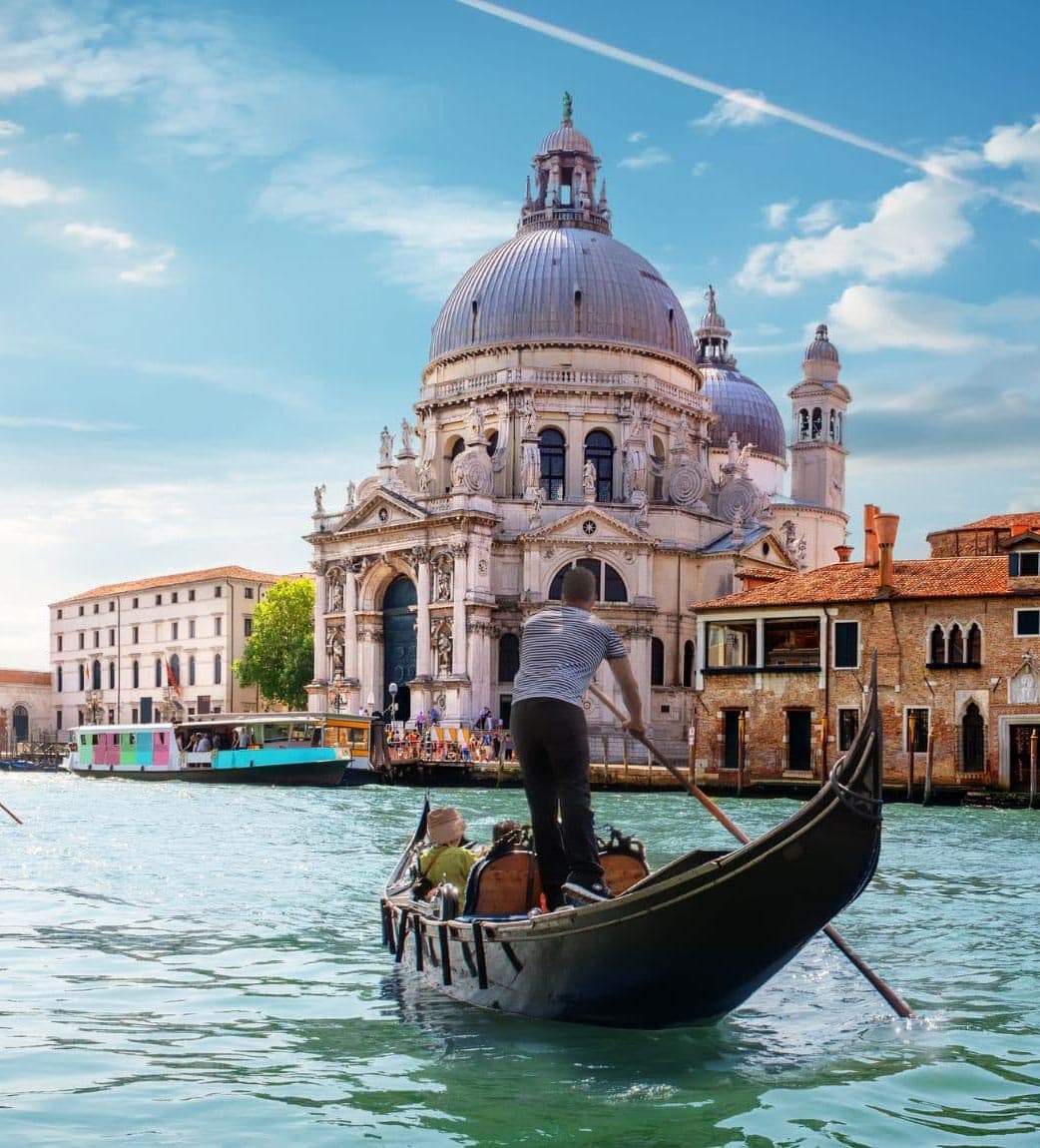
Venice at a Glance
Best Time to Visit Late September, October, February (Carnevale), April through May
Recommended Duration 3 nights minimum. 4 nights if the lagoon islands and artisan workshops are on the itinerary.
Starting From €400 per person per day
Top Experiences Venetian boatbuilding, Murano glass, cicchetti in Cannaregio, kayak through the lagoon, Torcello mosaics
Getting There Marco Polo Airport: 30 min by water taxi or 15 min by Alilaguna ferry to the city. Private water transfer arranged from any Venice hotel.

Why Venice Requires the Right Time, Place, and Guide

6 AM at San Marco. The only sound is your footsteps and the water.

I have a theory about Venice that I share with every client who asks me whether it is still worth visiting. The theory is this: the question is not whether Venice is worth visiting. The question is which Venice you are going to visit.

The first version receives up to 100,000 people per day in summer. Cruise ships begin docking at 9 in the morning, releasing 30,000 passengers directly onto the Riva degli Schiavoni. By 10, the Piazza San Marco is a slow-moving crowd. By noon, the calli between Rialto and San Marco are so compressed that you stop making decisions about where to walk. You follow whoever is in front of you. This version of Venice is not a travel experience. It is a queue that moves.

The second version exists at 6 in the morning. The piazza belongs to three or four people and a few gondolieri preparing their boats. The mosaics on the Basilica catch the early light in a way that photographs do not prepare you for. The Grand Canal is empty except for the vaporetti, and the reflections of the palazzi on the water have not yet been disturbed. This Venice is the one that explains why Goethe and Turner and Henry James kept coming back. It is available to anyone who stays overnight. It is invisible to the 80% of visitors who arrive by ferry in the morning and depart by ferry in the evening.

I should be honest about one season. I will not arrange Venice in July or August unless the client has accepted in advance that the experience will be managed around the crowds, not free of them. The canals are shallow. Summer heat concentrates whatever is in them. On certain windless afternoons in August, the smell is present enough to notice. This is not a reason to avoid Venice. It is a reason to visit in October, when the light on the lagoon turns amber, the crowds drop by 40%, and the city returns to something closer to its own character.

The Six Sestieri: Where to Stay in Venice: A Sestiere-by-Sestiere Guide

Most visitors never leave one of them. Here is what the other five contain.

Venice is divided into six sestieri. Most visitors spend their entire time in San Marco and the narrow strip leading to Rialto. This is understandable. It is also a significant waste of a city that rewards exploration in every direction.

San Marco is the sestiere that contains the Piazza, the Basilica, the Palazzo Ducale, the Rialto Bridge, and the highest concentration of tourists in Italy. The luxury hotels here are outstanding: the Gritti Palace on the Grand Canal, the Danieli on the Riva degli Schiavoni. My clients who stay in San Marco understand they are paying for position, not for tranquillity.

Dorsoduro is where I send clients who want Venice without the performance. The sestiere runs along the southern bank of the Grand Canal from the Accademia Bridge to the Punta della Dogana. It contains the Peggy Guggenheim Collection (housed in her palazzo on the Grand Canal, the lowest building on the water because she refused to allow the third floor to be completed), the Gallerie dell’Accademia with its complete sequence of Venetian painting from the 14th century forward, and the highest concentration of good bacari in the city. The university is here. So are the students, which means the neighbourhood has a working life that San Marco lost decades ago. For a Venetian honeymoon, Ca’ Maria Adele in Dorsoduro is my first recommendation: owner-run, intimate, no lobby visible from the street.

Cannaregio is the quietest sestiere and the most residential. It runs along the northern bank of the city, away from the Grand Canal tourist corridor. The Jewish Ghetto is here: the world’s first, established by decree on March 29, 1516. The buildings in the Ghetto are unusually tall, up to seven stories, because space was constrained and the population continued to grow. Two of the five original synagogues are still active. Walking through the Ghetto on a weekday morning, when the tour groups have not yet arrived, is one of the more affecting experiences Venice offers: a 500-year-old neighbourhood that has preserved its own character despite everything that has happened around it.

San Polo is the food sestiere. The Rialto market operates here every morning except Sunday, and the bacari that serve the market workers open at 8 AM. Cantina Do Mori, which has been pouring ombra de vin since 1462, is in San Polo. So is All’Arco, which makes the best crostini in the city from ingredients bought at the market that morning.

Santa Croce is the local sestiere. Tourists rarely reach it. The Aman Venice (in Palazzo Papadopoli, a 16th-century palazzo with a private garden) is in Santa Croce, which is instructive: the guests who choose it are not chasing proximity to the Piazza.

Castello is the eastern edge of the city. The Arsenale is here: founded circa 1104, the first large-scale assembly-line production facility in Europe, covering 45 hectares (15% of the entire historic centre). At its peak it employed up to 16,000 workers and could assemble a complete war galley in a single day using standardised parts, 400 years before Ford applied the same principle to automobiles. The Arsenale is now partly a naval base and partly the venue for the Biennale exhibitions. Castello also contains the Biennale’s Giardini, which houses the national pavilions, and the quietest canal walks in the city.

What to See Beyond the Postcard

The famous sights deserve more than the version most visitors experience.

Basilica di San Marco

The present basilica was begun in 1063 under Doge Domenico Contarini, built to house the relics of the Evangelist Mark. Over 4,000 square metres of gold mosaics cover the interior, many from the 13th century. The correct time to arrive is before 9 in the morning, when the free admission queues have not yet formed and the light enters through the western facade at the best angle. The Pala d’Oro, the Byzantine altarpiece behind the high altar, contains more than 3,000 precious stones. Most visitors walk past it because they are following an audio guide that has already moved on. I tell clients to find the Pala d’Oro first and give it ten minutes alone.

Palazzo Ducale and the Ponte dei Sospiri

The Great Council Hall (Sala del Maggior Consiglio) is 53 metres long and 25 metres wide, one of the largest secular interior spaces in Europe. Tintoretto’s Paradise covers the wall behind the doge’s throne. The Ponte dei Sospiri, connecting the palace to the New Prison across the Rio di Palazzo, was built around 1600 by Antonio Contino. The name was given to it by Lord Byron in the 19th century, a Romantic-era invention that has stuck. The truth is more mundane: by the time the bridge was built, most prisoners crossing it were serving minor sentences, not facing execution. Byron’s interpretation is the one the tourist postcards use. The architecture is extraordinary regardless of the backstory.

Ponte di Rialto

Built 1588 to 1591 by Antonio da Ponte, the Rialto Bridge won a design competition against Michelangelo, Palladio, and Sansovino. The single stone arch spans 28 metres and rises 7.5 metres above the water, supported by 12,000 wooden pilings. It was the only crossing of the Grand Canal for 263 years. The best time to see it is from a gondola at water level in early morning, when the tourist crush on the bridge has not yet gathered.

Squero di San Trovaso

Of the hundreds of squeri that once built gondolas in Venice, three remain. The Squero di San Trovaso in Dorsoduro, viewable from Fondamenta Nani, is the most accessible. The buildings are in an alpine style unusual for Venice, brought by craftsmen from the Cadore mountains. You cannot enter, but from the fondamenta you watch work in progress: sanding, painting, the careful shaping of the asymmetric hull that gives the gondola its distinctive lean. Each boat takes 45 days to build from seven types of wood.

The Artisan Venice That Is Disappearing

Three squeri remain. A handful of master tailors. The knowledge is held by fewer people every year.

Venice gondola boatbuilding squero workshop craftsman

The depopulation of Venice has a number attached to it that I find important to say directly: the historic centre had approximately 175,000 residents in 1951. Today it has fewer than 49,000. The families who once maintained the squeri, the atelier, the glassblowing fornaci, and the lace workshops on Burano have either moved to the mainland or ceased entirely. What remains is being sustained by people who chose to stay, and by a generation of younger artisans who are attempting a revival that is harder than it looks from the outside.

I arrange four experiences in Venice that do not appear on any aggregator platform because they require relationships that took years to build.

The first is Step Into the Heart of Venetian Boatbuilding (from €800 per person): access to a working squero where the marangoni are building and restoring gondolas using methods unchanged since the 16th century. You stand in a working yard with people who have chosen this craft as a life, and you understand from proximity something that no museum exhibit can convey about what it means to build a boat by hand.

The second is The Art of Venetian Tailoring (from €800 per person): an introduction to one of the last surviving Venetian sartorie producing bespoke garments using fabrics, velvet, brocade, damask, woven in the lagoon region. The tailors who work here supply houses whose names you know. The atelier itself is invisible from the calle outside.

The third is the Gondola Workshop (from €350 per person): a session with a master gondola craftsman covering the history and technique of building this asymmetric vessel, including the forcola (the oarlock, carved from a single piece of walnut and shaped differently for every gondolier). Approximately 433 licensed gondoliers remain in Venice. The knowledge required to build what they row is held by fewer than ten people.

The fourth is Kayak in Venice (from €120 per person). I recommend this not as an alternative to other transport but as the only way to understand the scale and silence of the lagoon at water level. On a kayak in the smaller canali in early morning, Venice stops being a backdrop and becomes a landscape. The dimensions are different from every other perspective. This is the experience that consistently produces the photographs clients frame rather than delete.

The Lagoon Beyond Venice: Murano, Burano, and Torcello

Not a checklist. A full day that most itineraries waste.

Every Venice itinerary mentions Murano, Burano, and Torcello. Most treat them as a half-day excursion compressed between breakfast and dinner on the main island. This is a mistake. The lagoon deserves a full day approached with the same attention as Venice itself.

Murano is where the Venetian Republic sent its glassmakers in 1291 by decree, for two stated reasons: furnaces burning at 1,500 degrees Celsius were a fire hazard in Venice’s wooden buildings, and the trade secrets of glassblowing were considered valuable enough to warrant isolation. Glassmakers who revealed techniques to foreigners faced serious consequences. The craft they developed in enforced quarantine produced the most refined glass in Europe for four centuries. Today the problem is different: the island is saturated with cheap imports displayed alongside the Venetian label. The way to tell the difference is the Vetro Artistico Murano trademark, and more reliably, watching a piece being made. I send clients to working fornaci where the maestro is present, not to showrooms.

Burano takes 40 to 50 minutes from Fondamente Nove on vaporetto Line 12. The coloured houses exist because the fishermen needed to identify their homes from the lagoon in fog. Each family chose a colour and it became theirs across generations. Today any resident who wants to repaint must apply to the municipal authority for an approved colour assigned based on location. The island is also known for its lacemaking tradition dating to the 16th century, now practiced by fewer than a dozen women, most of them elderly. The Museo del Merletto documents what the craft once was.

Torcello is the reason the lagoon day needs a full day. The island now has approximately 10 permanent residents and a famous restaurant: Locanda Cipriani, where Hemingway wrote parts of Across the River and Into the Trees. It also has the oldest surviving structure in the Venetian lagoon, the Cathedral of Santa Maria Assunta, founded in 639 AD. The mosaics inside date from the 11th and 12th centuries. The west wall carries a monumental Last Judgment that covers the entire surface. Most visitors to Venice have no idea it exists. Most of the ones who visit give it 20 minutes between vaporetti. I tell clients to give it an hour and a half, eat at the Locanda, and take the last boat back. That is a different experience from the half-day version.

What to Eat and Drink in Venice

The best food in Venice costs three euros and is eaten standing at a counter.

Venice has the highest concentration of bad tourist restaurants of any Italian city. It also has some of the most specific and distinctive food traditions in the country. The two things coexist because geography separates them: the bad food clusters around every major monument, and the good food is in the bacari of Cannaregio and San Polo.

The cicchetti tradition is Venice’s answer to tapas: small preparations served on bread or in paper cones, eaten standing at the counter with an ombra de vin (a small glass of local wine; the name comes from the practice of moving with the shadow of the Campanile to stay cool while drinking in the piazza). A cicchetto costs between one euro fifty and three euros. A proper cicchetti lunch in Cannaregio, moving between three or four bacari, costs less than a mediocre pasta at a restaurant near the Piazza and produces a better meal by a significant margin.

The dishes that define Venetian cooking: baccala mantecato (salt cod beaten with olive oil until it becomes a white mousse, served on grilled polenta), sarde in saor (sardines with sweet and sour onions, pine nuts, and raisins, a recipe the sailors developed to preserve fish on long voyages), polpette (dense meatballs, fried, not the loose version found elsewhere), fritto misto di mare (mixed fried seafood, which in a good bacaro uses whatever arrived from the Rialto market that morning).

Cantina Do Mori (Calle Do Mori, San Polo) has been operating since 1462. The room is dark and narrow and always full. Casanova reportedly drank here.

All’Arco (Calle Arco, San Polo, near the Rialto Market) opens early. The family buys at the Rialto fish market before 7 AM and prepares the crostini from what they find. The menu changes daily and is not written down.

Cantine del Vino gia Schiavi (Fondamenta Nani, Dorsoduro) is across the canal from the Squero di San Trovaso. The wine list is exceptional. Order the baccala and whatever the seasonal offering is.

Osteria al Squero (Dorsoduro, Fondamenta Nani) faces the gondola workshop directly. The crostini are good, but the reason to go is the view of the squero from across the canal.

Antica Osteria alla Vedova (Calle del Pistor, Cannaregio) is famous for its polpette, made to a recipe the family has not changed in decades. The clientele in the evening is Venetian.

My rule for Venice dining: if the menu has photographs, walk past. If someone is standing in the doorway inviting you in, walk faster.

When to Visit Venice and When Not To

The season changes the city more than almost any other destination I know.

Season Months Temperature Crowds Best For
Spring Apr–May 12–22°C Medium Light on the lagoon, lower prices than summer, Biennale preview
Early Summer June 18–27°C Medium–High Best summer month: before the August peak, Biennale in full swing (even years)
Peak Summer Jul–Aug 22–31°C Very High Overnight guests only. 100,000 daily visitors. 6 AM strategy essential.
Autumn Sep–Nov 12–24°C Medium–Low My first recommendation. October light. 40% fewer visitors. Acqua alta begins.
Winter Dec–Feb 3–10°C Low Fog on the canals. Venetians reclaiming the streets. Carnevale in February. Hotels 35–50% lower.

October is the month I recommend first. The light on the Grand Canal in late afternoon is the reason Canaletto painted the same scene 50 times. The crowds are gone. The city is itself again.

A word about the acqua alta. The acqua alta is a tidal flooding phenomenon caused by the combination of astronomical tides, sirocco winds from the southeast, and the Adriatic seiche effect. November is historically the worst month. In 2024 there were 219 events measuring 80 centimetres or more. The MOSE barrier, using 78 steel gates at the three lagoon inlets at Lido, Malamocco, and Chioggia, has been operational since October 2020 at a cost of over 6 billion euros and has been raised more than 97 times. The system works. Moderate acqua alta below 110 centimetres is not blocked and produces wooden walkways across the Piazza. To walk through the acqua alta in rubber boots on an October morning, with the Piazza reflecting the campanile and the city silent and largely empty, is one of the experiences that Venice offers that no other city in the world can replicate.

February brings Carnevale. My clients who want the experience receive access to private balls in historic palazzi rather than the public events on the Piazza, which are attended by 600,000 people in ten days and have the same crowd characteristics as August compressed into a shorter period.

The Biennale, held in even-numbered years (Art) and odd-numbered years (Architecture), occupies the Giardini and the Arsenale from May through November. Founded in 1895, it is the oldest international exhibition of contemporary art in the world. The vernissage in May is when Venice is at its most intellectually alive. Access to the vernissage requires accreditation. We arrange it.

How Many Days Does Venice Require?

I will not plan a Venice itinerary for one day. Here is why.

I decline to plan one-day Venice visits. Not because they are impossible but because they produce the version of Venice that people come home from disappointed by, and I would rather discuss an itinerary that works. The minimum is three nights. Here is what each additional night delivers:

Nights What becomes possible What day-visitors miss
1 night 6 AM San Marco. Evening passeggiata in Dorsoduro. Dinner at a bacaro. Dawn over the Grand Canal. The entire morning and evening character of the city
2 nights The sestieri circuit. Cannaregio Jewish Ghetto. Basilica interior at opening. Squero di San Trovaso. Rialto market at 8 AM. The residential city behind the tourist circuit
3 nights Full lagoon day: Murano glass workshop, Burano houses and lace, Torcello with a proper lunch at Locanda Cipriani. The lagoon, which is the entire reason Venice exists where it does
4 nights Boatbuilding or tailoring experience. Kayak morning. The Arsenale walk in Castello. One full day with no scheduled activities. The artisan city and the experience of Venice without agenda

For clients including Venice in a wider Italy journey, two structures work well: Florence to Venice by high-speed train (2 hours 10 minutes direct), or the Dolomites to Venice by private transfer through the Veneto countryside, stopping at a vineyard in the Prosecco hills above Treviso before arriving at the hotel by water taxi from the station. Our Highlights of Italy (from €3,500 per person) and A Journey Through Italy (from €2,590 per person) both include Venice with the context that makes the city make sense rather than appearing as an item on a sequence of days.


Venice Grand Canal gondola golden hour sunset reflection Italy Charme private tour

Frequently Asked Questions About Visiting Venice

Is Venice worth visiting?
Yes. The qualification is how you visit, not whether you visit. Venice as a day trip delivers a crowd-management exercise with some extraordinary architecture visible above the heads of other visitors. Venice with three nights, the right sestiere, and an early morning at San Marco delivers something that has no equivalent in any other city in the world. The city is improbable in its construction, specific in its culture, and irreplaceable. Go. Stay overnight. Wake at 6 AM. Revise your opinion entirely.
How crowded is Venice?
Between 25 and 30 million people visit Venice annually. The historic centre has a resident population under 49,000. On peak summer days, up to 100,000 visitors share the same streets, bridges, and vaporetti. The crowds concentrate in two corridors: San Marco to Rialto, and Rialto to the train station. Cannaregio, Santa Croce, Castello, and eastern Dorsoduro are significantly quieter at all times of year. The most effective crowd management strategy is not visiting in September instead of August. It is waking at 6 AM instead of 9 AM.
What is acqua alta and should it change my plans?
Acqua alta is tidal flooding caused by the combination of astronomical tides, sirocco or bora winds, and the Adriatic seiche effect. November is historically the worst month. In 2024 there were 219 events of 80 centimetres or more. The MOSE flood barrier, operational since October 2020, uses 78 steel gates at the three lagoon inlets and has been raised over 97 times to block the worst floods. Moderate acqua alta below 110 centimetres produces wooden walkways across the Piazza. My honest answer: acqua alta in October or November is atmospheric rather than disruptive for anyone who brings appropriate footwear. It should not change your plans. It might improve them.
How many days do I need in Venice?
Three nights is the minimum for a visit that covers the city properly. One night gets you the 6 AM city and the evening sestieri character. Two nights adds the Basilica at opening, the Rialto market, the Jewish Ghetto, and the Squero di San Trovaso. Three nights allows a full lagoon day with Murano, Burano, and Torcello at an unhurried pace. Four nights allows one of the artisan experiences plus a morning in a kayak through the smaller canali. I will not plan a single-day Venice itinerary.
Is a gondola ride worth it?
Once, in the right place, at the right time. The official rate is €90 for 30 minutes during the day and €110 for 35 minutes in the evening, per gondola for up to 6 passengers. On the Grand Canal at 2 PM in July, a gondola is a slow vehicle in heavy traffic. On the smaller canali of Cannaregio or Dorsoduro at sunset, when the light is low and the water is still, it is the experience the city was built around. I also recommend the traghetto for €2: a standing cross-canal ferry that uses the traditional gondola form and requires no queue. It is not romantic. It is practical, Venetian, and more representative of Venetian daily life than most of what the gondola operators near the Piazza offer.
Where should I stay in Venice: which sestiere?
San Marco for position and the Grand Canal facade hotels (Gritti Palace, Danieli): accept the crowds as part of the choice. Dorsoduro for art, good food, and a working neighbourhood feel: Ca’ Maria Adele is my first recommendation for couples. Santa Croce for the Aman Venice, which occupies a 16th-century palazzo with a private garden and is the finest hotel setting in the city. Cannaregio for clients who want the residential city and quiet. I do not recommend Mestre. Crossing the bridge to Venice every morning and back every evening is not a significant saving when the time and logistics cost are factored in.
What is the best time to visit Venice?
October is my first recommendation. The crowds drop by 40% from August. The light on the Grand Canal in late afternoon is the reason Canaletto painted the same scene 50 times. The temperature is comfortable for walking. Acqua alta begins in October but is manageable. February (Carnevale) is my second recommendation for clients who want an experience specific to Venice: private balls in palazzo, the costumes, the Piazza transformed. April and May work well. Avoid July and August unless the 6 AM strategy is accepted in advance.
What should I eat in Venice?
Start at the Rialto market before 8 AM to understand what the city eats. Spend the first lunch at a bacaro in San Polo or Dorsoduro: cicchetti at €1.50 to €3 each, standing at the counter with an ombra de vin. The key dishes: baccala mantecato, sarde in saor, polpette fritta, fritto misto di mare. Cantina Do Mori (San Polo, since 1462), All’Arco (Rialto market area), and Cantine del Vino gia Schiavi (Dorsoduro) are the three I tell every client to find. Avoid any restaurant whose menu is laminated and displayed facing the street.
Do I need to pay to enter Venice?
Yes, on designated days. The Contributo di Accesso applies on 60 days in 2026, primarily weekends and holidays from April through July, between 8:30 AM and 4:00 PM. The fee is €5 booked in advance or €10 on the day. Exemptions include hotel guests (who already pay a lodging tax), children under 14, Veneto residents, workers, and students. If you are staying overnight in a Venice hotel, the fee does not apply. This is one more reason to stay overnight rather than visit as a day-tripper from outside the Veneto.
What is there to do in Venice beyond San Marco?
Walk to the Jewish Ghetto in Cannaregio: the world’s first, established 1516, with buildings that reached seven stories because space was constrained and the population kept growing. Take the vaporetto to Torcello and spend two hours with the 639 AD cathedral mosaics, which are among the finest Byzantine works surviving in Italy and are visited by almost nobody. Watch the gondola carpenters work at Squero di San Trovaso from Fondamenta Nani. Walk the Arsenale perimeter in Castello and consider that this 45-hectare complex was assembling war galleys in a single day in the 12th century. Take a kayak through the smaller canali at dawn. Any one of these is a better use of an afternoon than standing in the queue for the Palazzo Ducale at noon.